

When these leaders asserted their country’s sovereignty, the U.S. overthrew them.
Nuvpreet Kalra, CODEPINK

From Israel’s occupation and genocide in Palestine, to threats of invasion of Venezuela, the endless proxy war in Ukraine, to military buildup pointing at China – there is one common cause, U.S. imperialism.
But what is U.S. imperialism? This is the capitalist stage where the U.S. seeks monopoly control over financial systems, resources, communications, weaponry, technology, and international organizations. With this control, it structures the world order around the exploitation of resources, land, and labor of other countries. When this dominance is challenged, the U.S. reacts with violence including threats, sanctions, invasions, or overthrowing the government and installing puppet regimes.
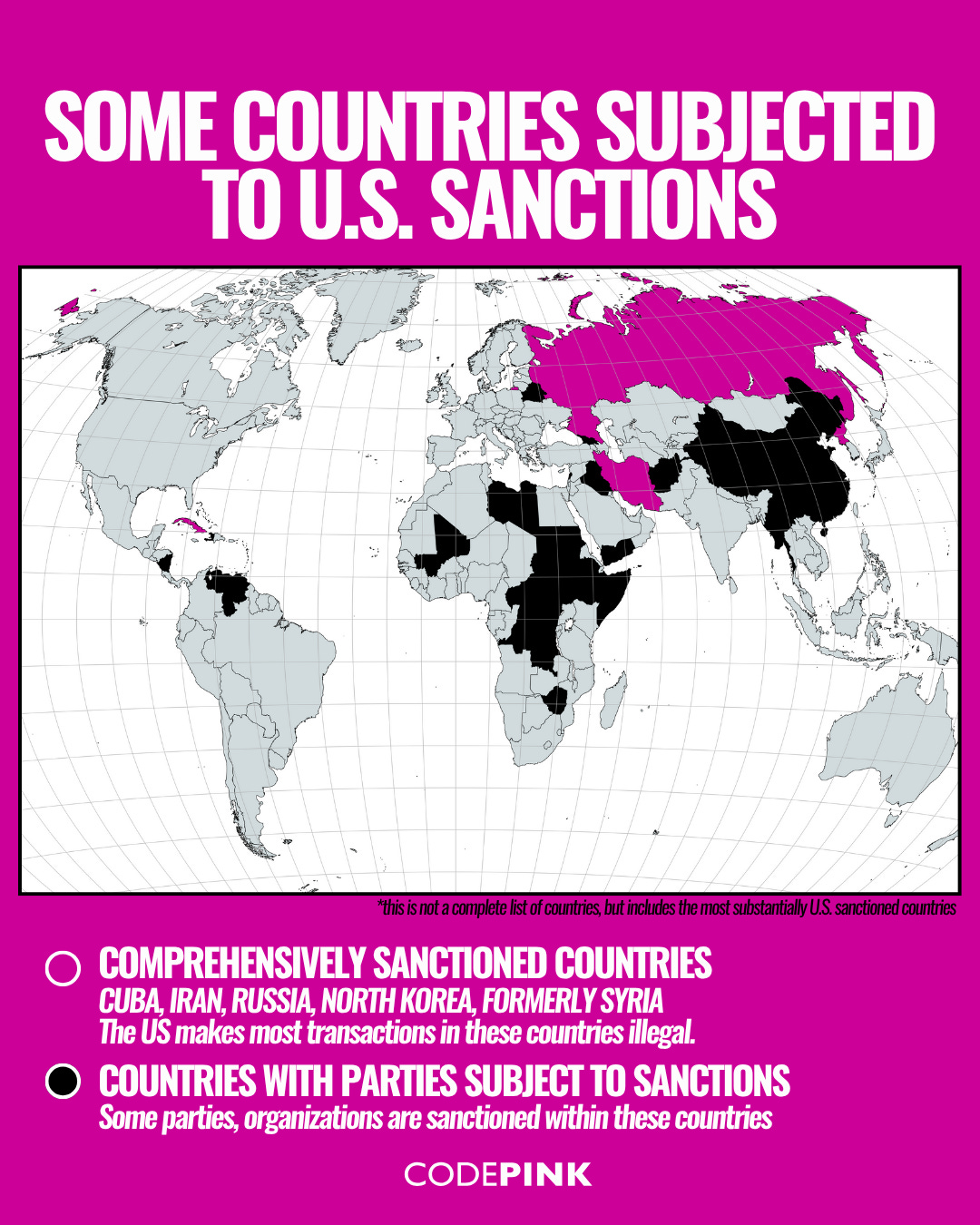
It takes one look at a list of sanctions across the world to see this is used to punish countries that threaten U.S. hegemony: Russia, Iran, Cuba, and North Korea. Until a few months ago, Syria was on this list. But after the successful regime change operation, Syria is no longer a threat but an asset to U.S. imperialism. One look at Netanyahu marching proudly in Israel’s newly colonized Syrian land or Syria’s puppet President Mohammad al-Julani laughing in the White House makes that certain.
The U.S. has become infamous for enforcing its will through coup d’etats. The most common, but not only, policy often follows: a country decides to stop letting foreign companies exploit its resources and dictate its policy aimed at keeping people poor; the U.S. and allies impose economic warfare, fund and train opposition militias, and fund propaganda campaigns; then these U.S.-backed and funded groups overthrow the government, install a pro-U.S. dictatorship and restore the neocolonial systems of exploitation. The U.S. uses a plethora of covert and overt intervention against those it perceives as its enemies.
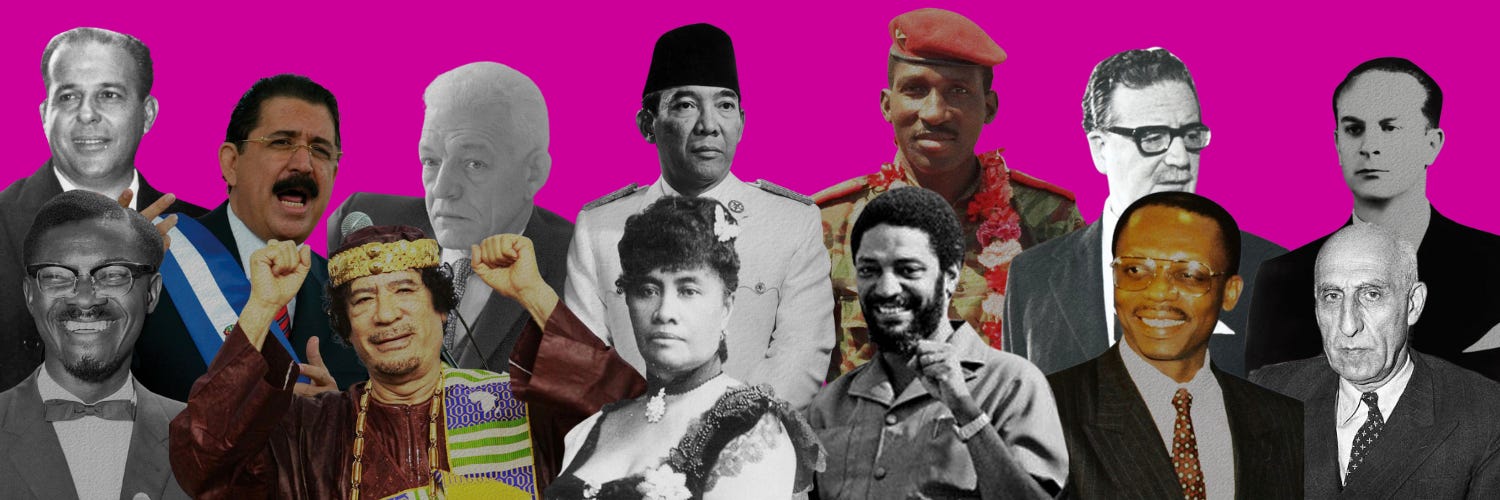
Here is a list of some of the leaders the U.S. overthrew because they asserted their own sovereignty and challenged U.S. exploitation:
Queen Liliʻuokalani was monarch of Hawai’i who attempted to pass a new constitution asserting Hawaiian sovereignty to suppress the economic and political power of the Anglo-American wealthy plantation owners. Sugar plantations were lucrative for the white planter class who feared they would lose their beneficial duty-free arrangements under the 1876 Reciprocity Treaty. In January 1893, the U.S. military invaded and overthrew the Hawaiian Kingdom which formally annexed the islands to the United States by 1898. The U.S. exploited Hawai’i as a military outpost, expropriated sugar and pineapple, and completely controlled the islands.
Mohammad Mossadegh was elected Prime Minister of Iran in 1951 on the grounds of oil nationalization, to end decades of British plunder of Iranian oil. In response, the U.S. and UK toppled Mossadeq in a coup and installed Mohammad Reza Shah, who allowed the British to continue plundering Iran’s oil, let the CIA and GCHQ run wild, recognized and opened a de facto Israeli embassy, and was used as a pawn against the Soviet Union during the Cold War.
Jacobo Árbenz was elected president of Guatemala in 1950 when companies like United Fruit were exploiting the country to make huge profits. When Árbenz took office, 70% of Guatemalan land was in the hands of 2% of the population, including the United Fruit Company. In the following years, around 1/8 of the population received land distributions in decrees that included idle UFC land, which was compensated at more than it was bought for. The company spent the equivalent of over $6 million dollars to lobby against Árbenz in the U.S. and many members of the U.S. government were linked to the UFC, which led to the U.S. launching Operation PBSuccess. They armed a militia which invaded the country in June 1954, launched widespread psychological warfare, and forced Árbenz into exile to preserve some of the gains of the government. The new pro-U.S. Armas dictatorship imprisoned, tortured, and killed thousands of Guatemalans, including over 1,000 United Fruit workers, repealed the agrarian reform, made Guatemala a freely exploitable plantation for the U.S., and plunged the country into a decades-long civil war.
Patrice Lumumba was elected the first Prime Minister of the independent Democratic Republic of the Congo in 1960 after leading the pro-independence group which secured Congo’s liberty from Belgium. Despite gaining independence, Congolese minerals were being plundered for the profits of Belgian companies. As a result, Lumumba began to nationalize the mines, kick Belgian companies out, and seek vehicles from the Soviet Union to develop national copper, diamond, and cobalt mining. Belgium, Britain, and the U.S. plotted to stop these attempts at Congolese sovereignty and use of resources for the Congolese people by funding and arming counterinsurgents, freezing the treasury, and cutting off all flows of credit. In 1961, after Lumumba refused to accept their attempts at deals for exploitation, Belgian and U.S.-backed proxies and officials kidnapped and brutally murdered Lumumba and installed pro-U.S. and pro-Belgian puppet Mobutu in government. He returned the mines to Belgian companies, pegged copper prices to the dollar, and returned Congo to an exploited and extracted mine and plantation for U.S. and European companies.
Juan Bosch became president of the Dominican Republic in February 1963 in the first election after three decades of the Trujillo dictatorship which funnelled major exports, notably sugar, to the U.S. and let U.S. companies own large swathes of land and industry. Bosch’s government introduced a new progressive constitution with guarantees for the working class, deemed health a human rights, land reform, banned new U.S. oil refineries, barred foreign troops, and challenged the corrupt military state. The U.S. armed and trained the Dominican military, which in September 1963, seized power and forced Bosch into exile. The coup declared national siege and dissolved the new constitution, overturning the progressive changes. In 1965, the U.S. directly invaded the Dominican Republic after tens of thousands of people protested to demand Bosch’s restoration. They installed Jaoquin Balaguer who killed thousands of protestors and unravelled the restrictions on U.S. companies and troops, allowing the country to be once again pillaged by the U.S..
João Goulart became President of Brazil in 1961 on a mandate for agrarian reform and to limit the large profits extracted by large multinational companies, including ITT and Standard Oil. To protect corporate profits and oppose any sovereignty for Brazil, the U.S. launched “Operation Brother Sam”, a coup effort to arm and support militia to overthrow the government. In 1964, these U.S.-backed forces rebelled in army barracks in an attempt to wage civil war. Goulart fled in an attempt to stop the violence. The U.S. installed a pro-U.S. military dictatorship, which it immediately provided economic aid and training to; the dictatorship tortured, killed, and disappeared thousands of progressives in Brazil until 1985.
Sukarno led the struggle against Dutch colonialism and became the first president of newly independent Indonesia in 1945. He sought a path for sovereignty and national unity in Indonesia and nationalized some foreign assets as well as leading tricontinentalism, particularly with the Bandung Conference, and the Non-Aligned Movement. In 1965, the U.S. and UK backed General Suharto’s coup against Sukarno which installed a military dictatorship which killed over one million communists, trade unionists, and anyone seen as aligned with the Indonesian Communist Party. Sukarno was placed under house arrest and Indonesia was once more open for exploitation and extraction from multinational corporations.
Salvador Allende was elected president in 1970, at the chagrin of the U.S,. who immediately instituted suffocating measures: the U.S. shut down aid to Chile, blocked the country from accessing dollars through commercial means, and encouraged transnational firms to seize overseas Chilean assets. Despite this, Allende’s government increased their vote share in the 1973 election. The turning points came with Allende’s nationalization of copper as well as his leadership and drive to create the New International Economic Order, to restructure the international order in favor of the Third World. In September 1973, the U.S. funded and commanded a coup to overthrow Allende, led by Pinochet. Allende died, Pinochet seized power, and installed a military dictatorship that massacred over 3,000 people and tortured over 40,000 people.
Maurice Bishop was leader of the New Jewel Movement in Grenada who led a revolution to overthrow the repressive regime of Eric Gairy in 1979. Bishop’s government was a popular and progressive force that increased literacy rates from 65 to 95% among young adults, expanded healthcare massively, nationalized key sectors, and contributed significantly to the Non-Aligned Movement. The U.S. immediately implemented economic sanctions, military threats, and blocked international loans to destroy the revolution. The U.S. suffocation caused fractures within the government which ultimately led to Bishop’s assassination by members of his own party, which the U.S. used as grounds to invade Grenada under ‘Operation Urgent Fury’ which unravelled the revolution and re-affirmed the British colonial governor of Grenada.
Thomas Sankara led an anti-imperialist revolution in Burkina Faso in 1983, ending IMF austerity and enacted widespread reforms to make Burkina Faso self-sufficient. He nationalized key industries, denounced foreign debt, launched land reform, irrigation projects, local cotton production, and other major reforms that were aimed at overturning the previous agreements that pushed the majority of Burkinabe into a state of exploitation. His Pan-Africanist and socialist ideology posed a threat to the U.S., which overthrew his revolution and killed Sankara via their intelligence assets to turn Burkina Faso into a U.S. client state. Compaoré’s government immediately restored IMF austerity, recognized Israel, and let the U.S. and France back in to exploit the country for military and economic means.
Jean-Bertrand Aristide was elected as President of Haiti in 1990, ending nearly three decades of the brutal U.S.-backed Duvalier dictatorships. Aristide’s government prioritized the Haitian people, including more than doubling the minimum wage, launching Creole literacy campaigns and massively increasing literacy rates, and expanded healthcare. In 1991, a U.S.-funded and trained military junta violently overthrew the government. The U.S. said Aristide could return to power only if he agreed to brutal neoliberal programs to open Haiti to exploitation from foreign companies. Aristide agreed to the essential ransom, until 2004 when he rejected the Washington Consensus and demanded reparations from France from their extortion. In quick succession, France and the U.S. kidnapped Aristide and forced him into exile. Haiti was made into a super-exploited country for the benefit of western countries and governments.
Manuel Zelaya was elected President of Honduras in 2005 on a mandate to challenge the U.S. and oligarchy’s exploitation of the masses. Honduras was treated as a super-exploitable sweatshop where large companies made huge profits at the expense of the people of Honduras and their environment. Once in office, Zelaya raised the minimum wage by 62%, joined ALBA, and called for a referendum to re-write the imperialist constitution written by the United States in 1982. This sparked fear in the U.S., so on the day of the referendum, the U.S. ordered a coup of the government. U.S.-trained and backed generals were ordered to storm Zelaya’s residence, kidnap him, and install the U.S.-backed Micheletti government which re-instituted IMF austerity, cancelling of the wage increase, and opening of Honduras for U.S. military bases. Honduras was left exploited and poor, with one of the highest rates of crime in Latin America, until the election of Xiaomara Castro, Zelaya’s wife, in 2022 who has worked to institute some socialist reforms including raising the minimum wage and negotiating IMF debt.
Muammar Gaddafi led a revolution to overthrow the monarchy and corrupt regime of Libya in 1969. Under his government, Libya developed from one of the poorest countries in Africa into one of the most prosperous by using nationalized oil revenues to provide free education, electricity, healthcare, made housing a human right, ended taxation, and distributed huge amounts of money. After Gaddafi moved to create a sovereign currency, blocked AFRICOM, and challenged U.S. oil interests, the US-NATO invaded Libya in 2011, murdered Gaddafi, pillaged Libya, and devestated the country which led to the current operation of an open air slave trade.
The time of monsters
There are many more examples of leaders and governments the U.S. and other imperialist powers have successfully overturned. The aim of installing these pro-U.S. puppets gives the illusion of sovereignty for countries with the ultimate power held in the U.S.. These countries are wrecked by IMF austerity, exploitation of the resources that should be used for prosperity, and enforced domestic policy in the interests of the national elites and imperialists rather than the people.
When our politics are rooted in history, or even history not that long ago, the present situation becomes very clear. As we look today, there are many countries the U.S. has interests in overthrowing. Right now this is most evident in Venezuela, where the Trump administration has openly declared it is seeking to coup the Maduro government, given the ever increasing bounty on the head of the democratically elected leader. This follows the same lines as previous U.S. imperialist intervention given the many attempts to overthrow the Bolivarian Revolution since 1998. Venezuela refuses to be an exploited mine loyal to U.S. interests and international policy, and for that reason, the United States will not let it exist as is. With a similar lens, we can look at China and Iran as two countries that are too strong for the U.S. to overthrow using its traditional means, so it bombs (in the case of Iran), sanctions, and threatens all out war.
The United States seeks to maintain its hegemony violently across the world. As we see the waning of the unipolar world in which the U.S. has been able to act as world power in dominating economics, politics, and culture, other countries are now challenging this. China and the rising Global South are posing a challenge to this international order. That is why the U.S. continues to do everything in its power to attack, demean, and undermine them.
It is up to us to educate and mobilize people to recognize and firmly believe that another world is possible. A world where the United States can’t terrorize, attack, genocide, murder, and occupy people. A world where there are rules for some, and not for others. A world which ends the system that for some to prosper others must suffer. Like Gramsci famously put, “the old world is dying and the new world struggles to be born, now is the time of monsters.” Let us move to defend the sovereignty of people across the globe, confront the nasty face of U.S. imperialism wherever it rears its head, and struggle together for a world based on humanity, justice, and liberation.
Join CODEPINK’s Venezuela Rapid Response Team!
And Take Action for Palestine!
Nuvpreet is CODEPINK’s Digital Content Produce & Bases Off Cyprus Campaign Coordinator
Nuvpreet is based in London, England. She completed a Bachelor’s in Politics & Sociology at the University of Cambridge, and an MA in Internet Equalities at the University of the Arts London. Her studies focused on racialised surveillance capitalism, with a focus on Artificial Intelligence as a weapon of war and settler colonialism. Nuvpreet joined CODEPINK as an intern in 2023, and now produces digital content, co-ordinates the Bases Off Cyprus campaign, and organises against imperialism in Britain.